Does DCENT support HD wallet addresses? / What is HD wallet multi-address?
This article explains what DCENT's HD Wallet Multi-Address (address rotation) feature is, how to enable and disable it, and how addresses are shown on different screens.
An HD wallet (Hierarchical Deterministic) is the standard way to systematically generate and manage many addresses from a single seed, used by DCENT and most modern wallets. The HD Wallet Multi-Address (address rotation) feature covered here applies to Bitcoin-family coins.
HD Wallet Multi-Address uses a new address each time you receive Bitcoin-family coins, strengthening your privacy. Compatibility with other wallets that use the same seed (BIP44 standard) is fully maintained.
⚠️ [Lab feature notice] This is a Lab feature that DCENT provides experimentally, and it may change, be paused, or be removed at any time. By enabling it, you are deemed to agree that use of the feature is entirely at your own responsibility.
[Enabling / disabling multi-address (rotation)]
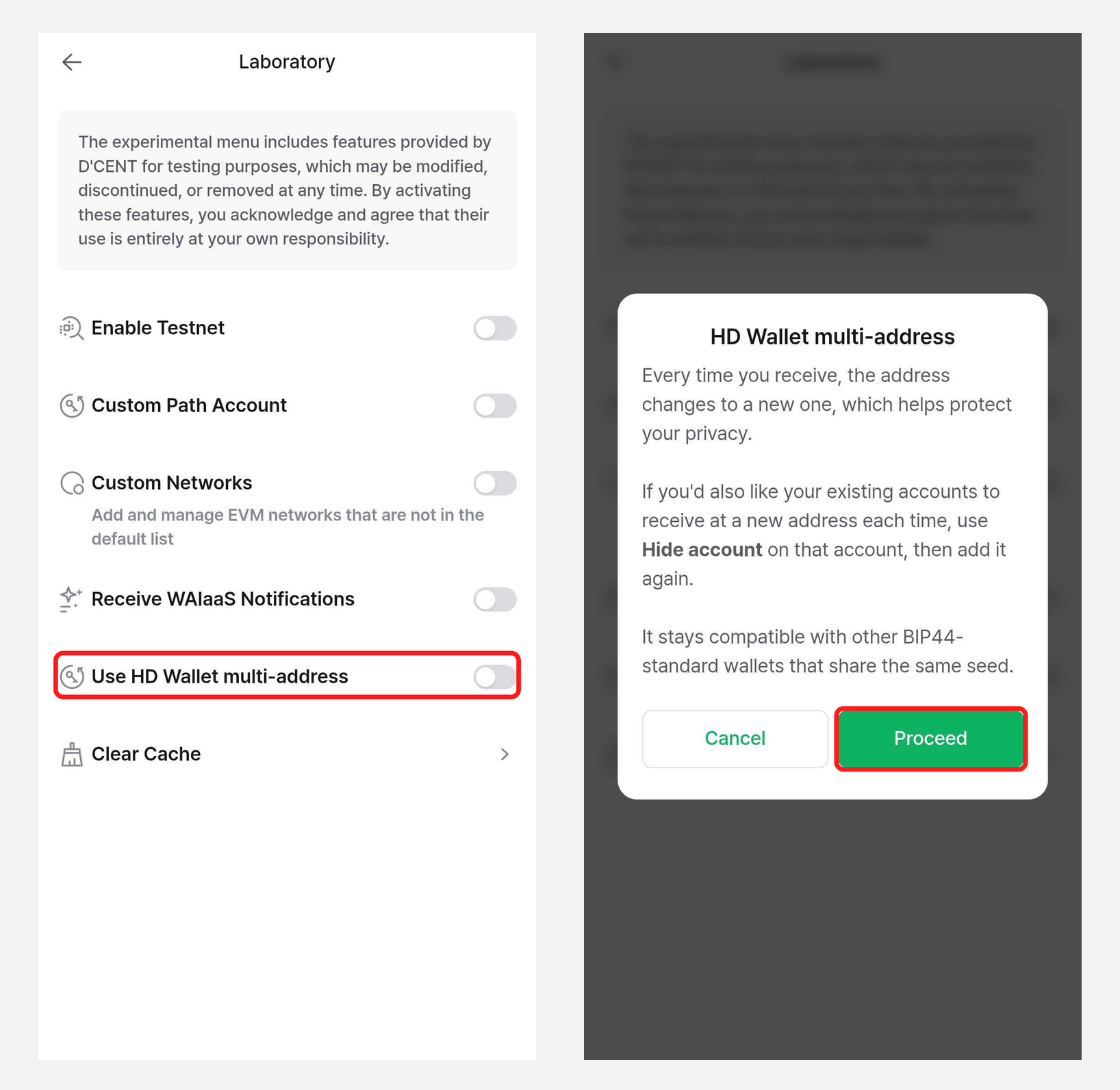
Enabling
- In the DCENT mobile app, go to [Settings] → [Lab].
- Enable "Use HD wallet multi-address", then tap "Continue" on the dialog.
- After enabling it, rotation applies to Bitcoin-family accounts you newly create.
- Existing accounts are not converted automatically. To apply it to an existing account, hide that account and then create it again.
Disabling
- Disable "Use HD wallet multi-address" on the same [Lab] screen.
- Even when disabled, the account's multi-address set is kept, and only a single representative address is used for receiving.
Checking the current status on the Receive screen
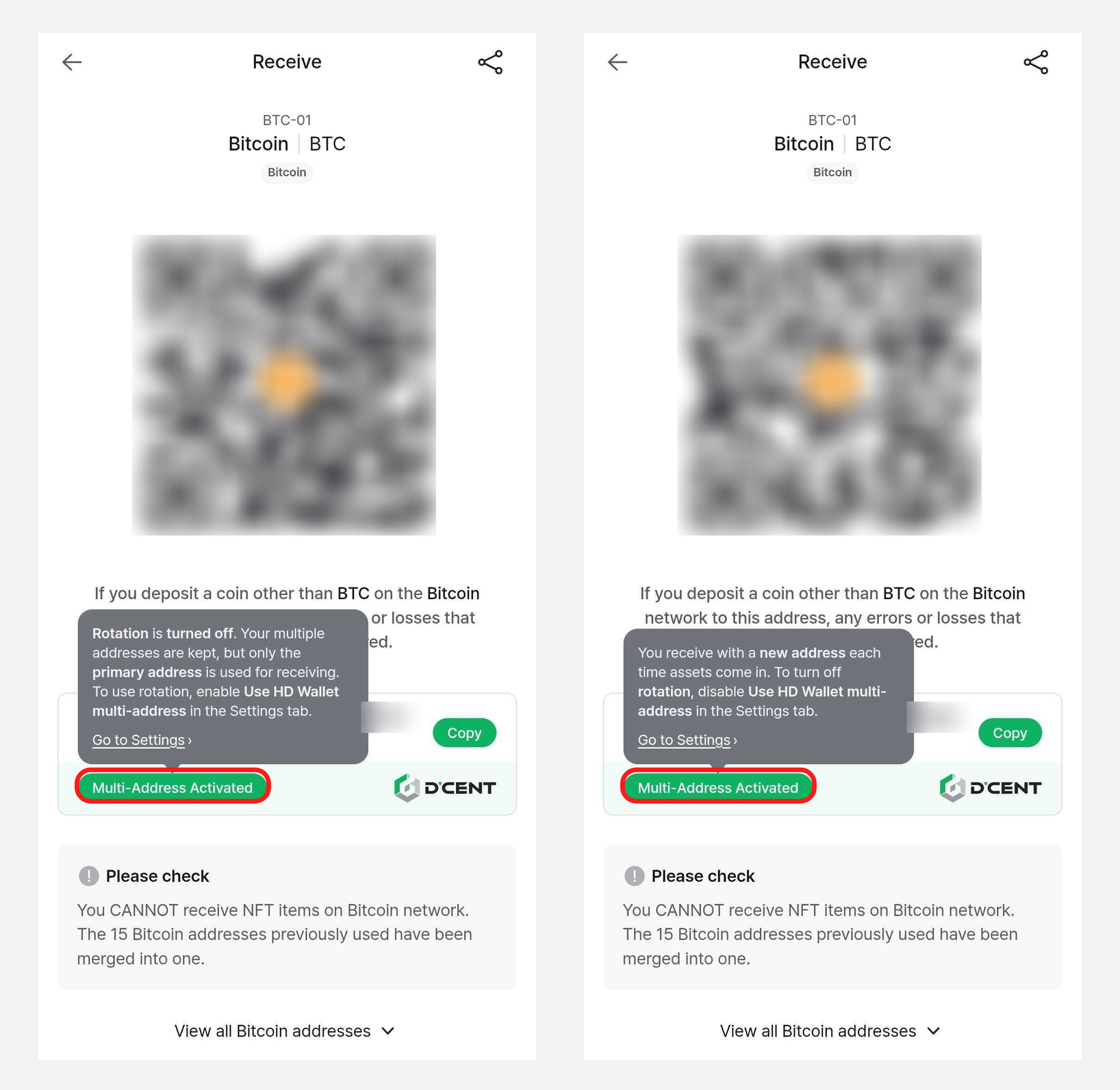
Tapping the "Multi-address enabled" badge on the Receive screen shows the account's current status (on/off). The notice includes a "Go to settings" link that opens the Lab settings screen — the actual enabling/disabling is done in [Lab], not on the Receive screen.
- Account with multi-address ON: a notice tells you that you receive with a new address each time.
- Account with multi-address OFF: a notice tells you that the multiple addresses are kept but only the representative address is used for receiving, so you can check whether your account has multi-address turned off.
[Receive address before vs. after enabling]
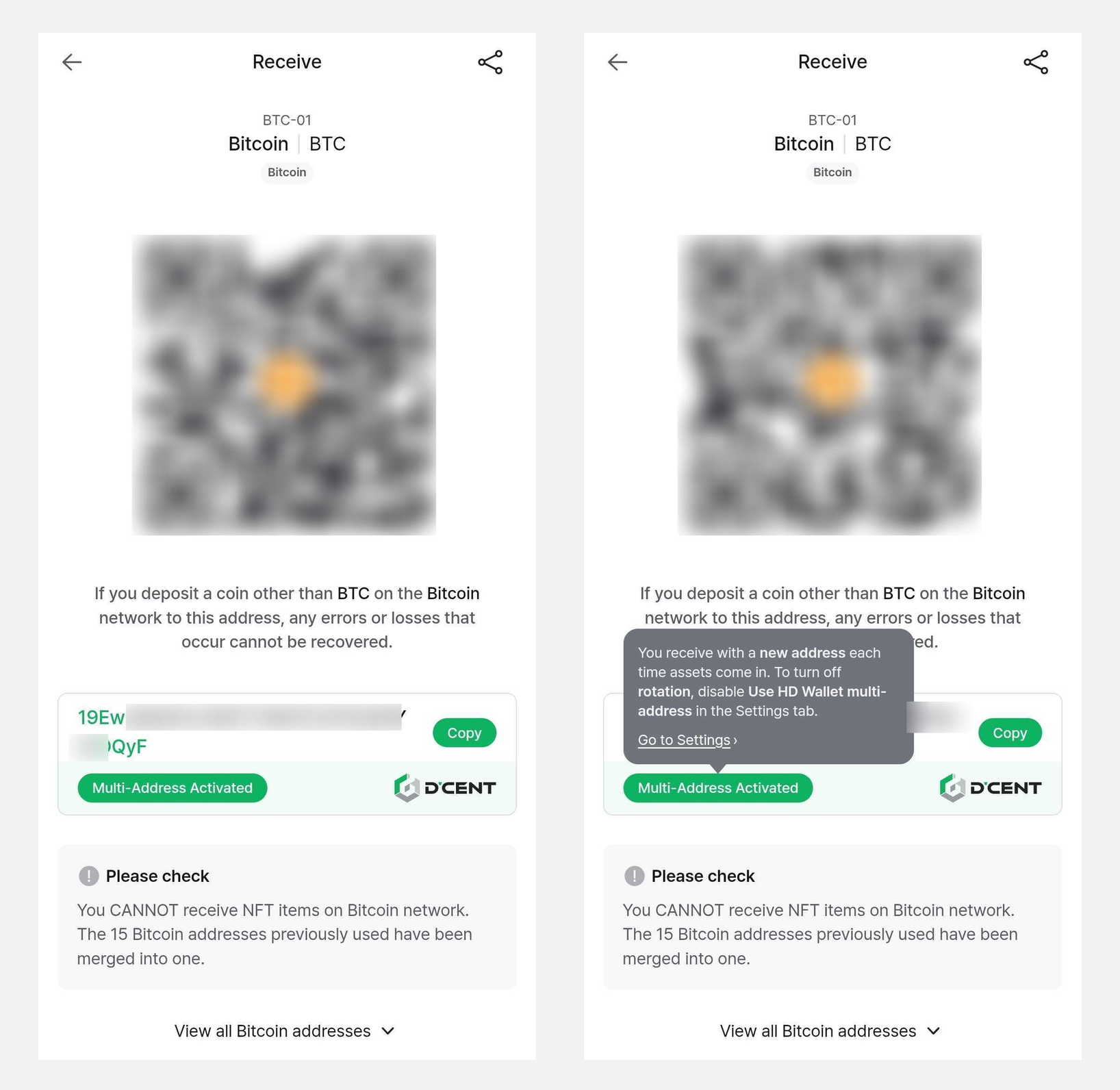
- Before: the Receive screen shows a single, fixed representative address.
- After: a new address is shown each time you receive, along with a "Multi-address enabled" badge.
- Once you receive to the shown address, the next time you open the Receive screen it automatically changes to the next new address.
[The address looks different on each screen]
With rotation, the address shown can differ from screen to screen, which is normal.
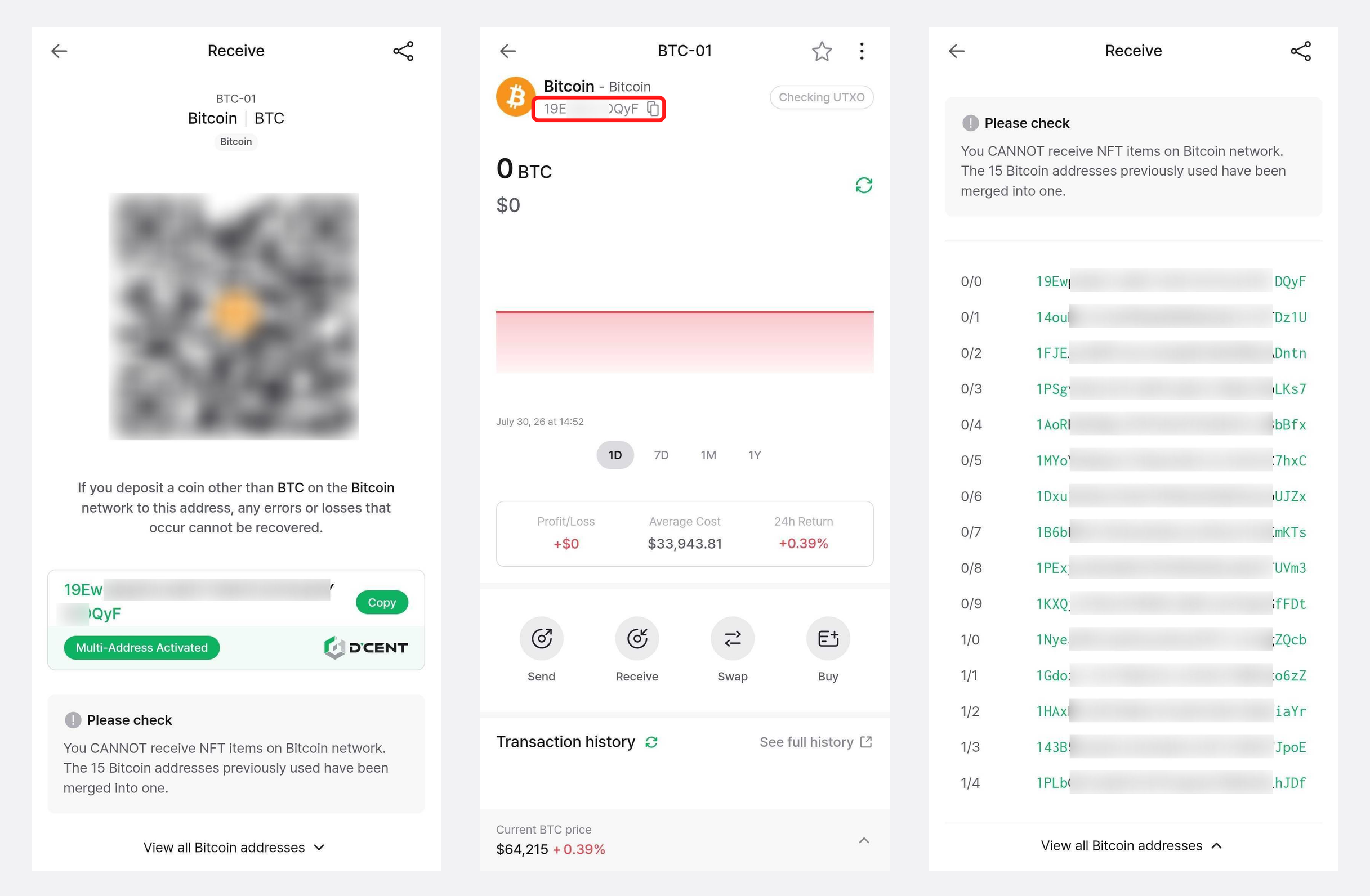
- Receive screen: shows the current rotated (new) address you can receive to right now.
- Account detail · transaction history header: shows the account's representative address (fixed). This stays the same even as the receive address changes.
- View all Bitcoin addresses: tap "View all Bitcoin addresses" at the bottom of the Receive screen to see the account's full address list.
[How many addresses are used?]
- A Bitcoin account uses a fixed total of 15 addresses (10 receiving + 5 change).
- When receiving, the next unused address among the receiving addresses is shown in order.
- Once all receiving addresses are used, no new addresses are created — it cycles back and reuses from the first address.
- An address that has ever received coins is not shown as a "new address" again, even after its balance is fully withdrawn.
[What happens when sending?]
- When sending, the wallet aggregates the balances (UTXOs) across your multiple addresses. As a result, the From address in your transaction history may be shown based on the address actually used for that transfer (one of the 15).
- Any remaining amount (change) returns to your own change address.
- For more about UTXOs, see Why is the Bitcoin transaction fee so high? / What is a UTXO?.
[Supported coins (Bitcoin family)]
This feature applies to the following Bitcoin-family coins:
- Bitcoin (BTC) / Bitcoin SegWit
- Bitcoin Cash (BCH)
- eCash (XEC)
- Zcash (ZEC)
- Litecoin (LTC)
- Bitcoin Gold (BTG)
- Dash (DASH)
- DigiByte (DGB)
- Ravencoin (RVN)
- Dogecoin (DOGE)